
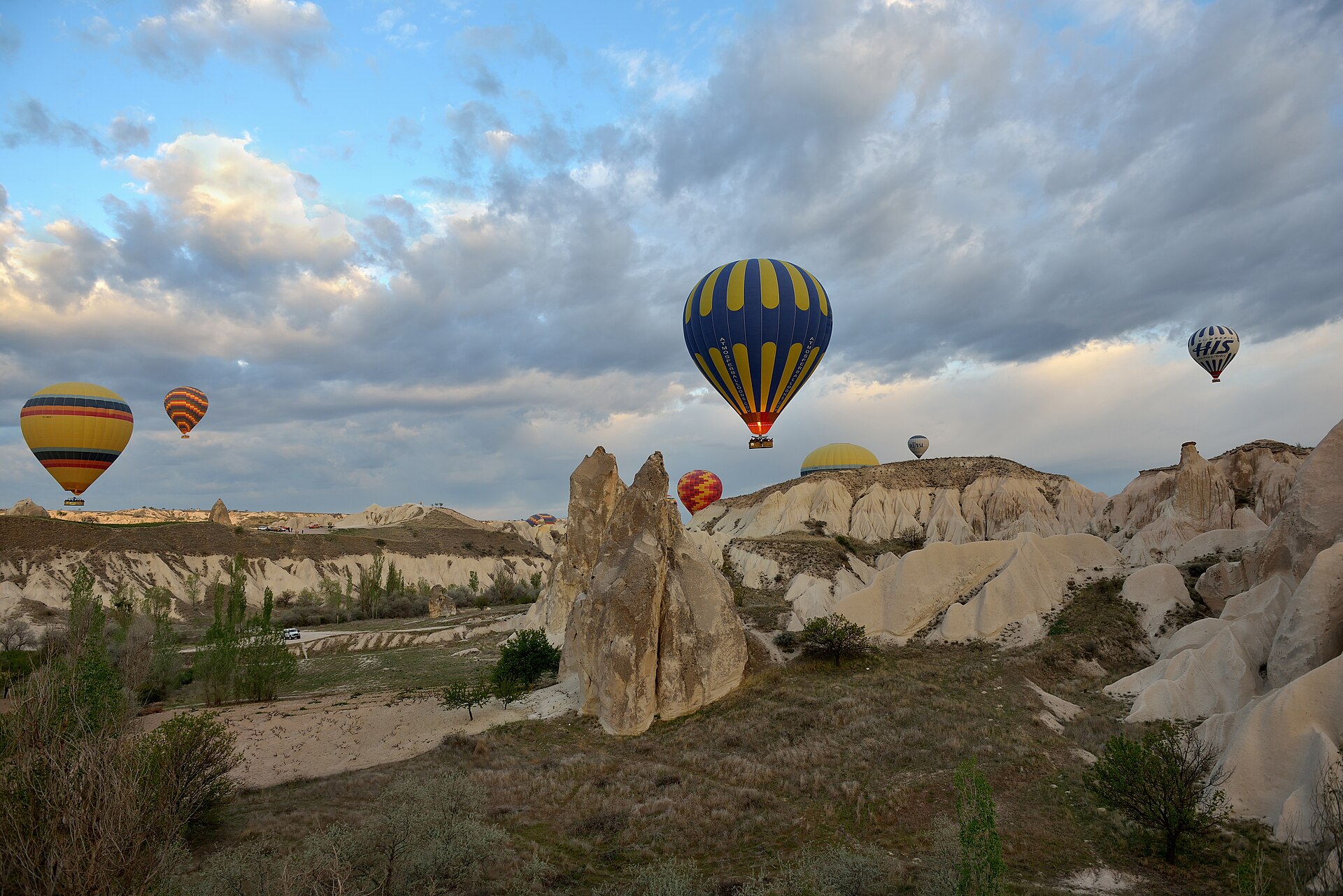
Cappadocia is the part of Turkey that looks least like anywhere else. A few million years of volcanic ash settled into a soft rock called tuff, and wind and water have been carving it ever since into cones, ridges and the tapering pillars everyone calls fairy chimneys. People have been digging into that same soft rock for far longer — for homes, churches and whole cities underground. The result is a landscape you both walk across and sleep inside.
The region sits in central Anatolia, a long way from the coast, and most visitors base themselves in the small town of Göreme at its centre. From there the valleys, viewpoints and villages are close together, which is why two or three unhurried days cover the essentials without ever feeling rushed.
Göreme and the balloons
Göreme is the practical heart of a Cappadocia trip: a compact grid of pensions, cave hotels, tour desks and cafés, hemmed in by rock cones on every side. It is also the launch zone for the thing that put the region on most travellers’ lists — the dawn balloon flight.
On a clear, calm morning, hundreds of balloons lift off together as the sun comes up, drifting low over the valleys before climbing for the wider view. It is genuinely spectacular, and it is also weather-dependent: wind grounds the fleet regularly, and cancellations are common enough that you should plan for them rather than be surprised by them. Book your flight for early in your stay so a scrubbed morning still leaves you a spare day to try again. Prices run roughly 150 to 300 US dollars per person for about an hour in the air, and capacity is capped by the civil aviation authority, so peak-season mornings sell out — reserve ahead. If you would rather understand the whole process before you commit, our Cappadocia balloon guide covers timing, costs, cancellations and how to choose an operator.
Not flying is a perfectly good choice too. From a hotel terrace or a hillside above Göreme, watching the balloons fill the sky costs nothing and is, for many people, the better vantage point anyway.
The open-air museum and the rock churches
A short walk or drive from town, the Göreme Open-Air Museum is the single best introduction to the region’s history. It is a cluster of rock-cut Byzantine churches and monastic cells, several with frescoes still bright on their curved ceilings, and it holds UNESCO World Heritage status. Come early or late to sidestep the tour-bus crush in the middle of the day; the frescoed Dark Church, which carries a small extra charge, is worth it for how well its colours have survived.
The churches here are the polished, protected version of something you find scattered all over Cappadocia — chapels and dwellings hollowed straight out of the cliffs, many of them free to poke around on a valley walk.
Underground cities
The same soft rock that made carving churches easy also made it possible to dig downward, and Cappadocians did so on a startling scale. At Derinkuyu and Kaymaklı you can descend through several levels of a full underground city: stables, kitchens, wells, ventilation shafts and huge stone doors that could be rolled across passages to seal them from the inside. They were built as refuges, somewhere whole communities could disappear when raiders swept through.
The passages are narrow and low in places, so they are not for everyone, but they are one of the most memorable stops in the region. Derinkuyu is the deeper of the two; Kaymaklı spreads more sideways. Either one gives you the idea, and combining a city with a valley hike makes a well-balanced day.
The valleys and villages
Cappadocia rewards walking. Red Valley and Rose Valley, side by side, hold the best light of the day and are the classic late-afternoon hike, their rock walls turning warm shades as the sun drops — bring water and start with enough time to finish before dark, as the trails are unlit. Devrent, often called the imagination valley, is a short strolling loop where the rock has weathered into shapes people love to name; Paşabağ, the monks’ valley, has some of the tallest and most photographed fairy chimneys, several capped with a darker stone.
For height, Uçhisar Castle is the region’s highest point, a giant rock riddled with tunnels and rooms that gives a 360-degree view across the whole area — a good orientation stop early in a trip. And on the Kızılırmak river, the pottery town of Avanos has been shaping the local red clay for generations; a workshop visit, wheel and all, is an easy and hands-on hour.
Where to stay
The signature Cappadocia stay is a cave hotel, with rooms cut into the rock so the walls stay cool in summer and warm in winter. They range from simple pension rooms to genuinely luxurious suites, and the best of them come with terraces angled at the sunrise balloons. Göreme is the most central base; Uçhisar and Ürgüp are quieter and often smarter, with wider views. Our where to stay guide breaks down the villages so you can match the base to the kind of trip you want.
When to go
The comfortable windows are spring, roughly April to June, and autumn, September and October — mild days, cooler nights and, importantly, the clearer, calmer conditions that give balloons their best chance of flying. Midsummer is hot and the busiest time of year. Winter is quieter and can be beautiful, with snow softening the rock cones, but it brings more grounded mornings, so anyone coming mainly to fly should weigh that in.
Whatever month you choose, the region is high and dry, so pack for a real swing between daytime warmth and cold mornings, especially if you are up before dawn for a launch.
Getting there and around
Cappadocia has two airports within reach: Nevşehir (NAV), closer to Göreme, and Kayseri (ASR), a little further but with more flights, both an hour or so from the main towns by transfer. Most visitors fly in from Istanbul. Overnight buses also run from the big cities and drop into the regional hub at Nevşehir.
Once you are there, the sights are spread across a compact area but not all walkable, so a mix works best: hike the valleys on foot, and use a small-group tour, a hired driver or a rental car for the underground cities and the further-flung viewpoints. Browse the Cappadocia tours to see the guided options, from balloon-and-breakfast mornings to full-day loops of the churches, cities and valleys.


