
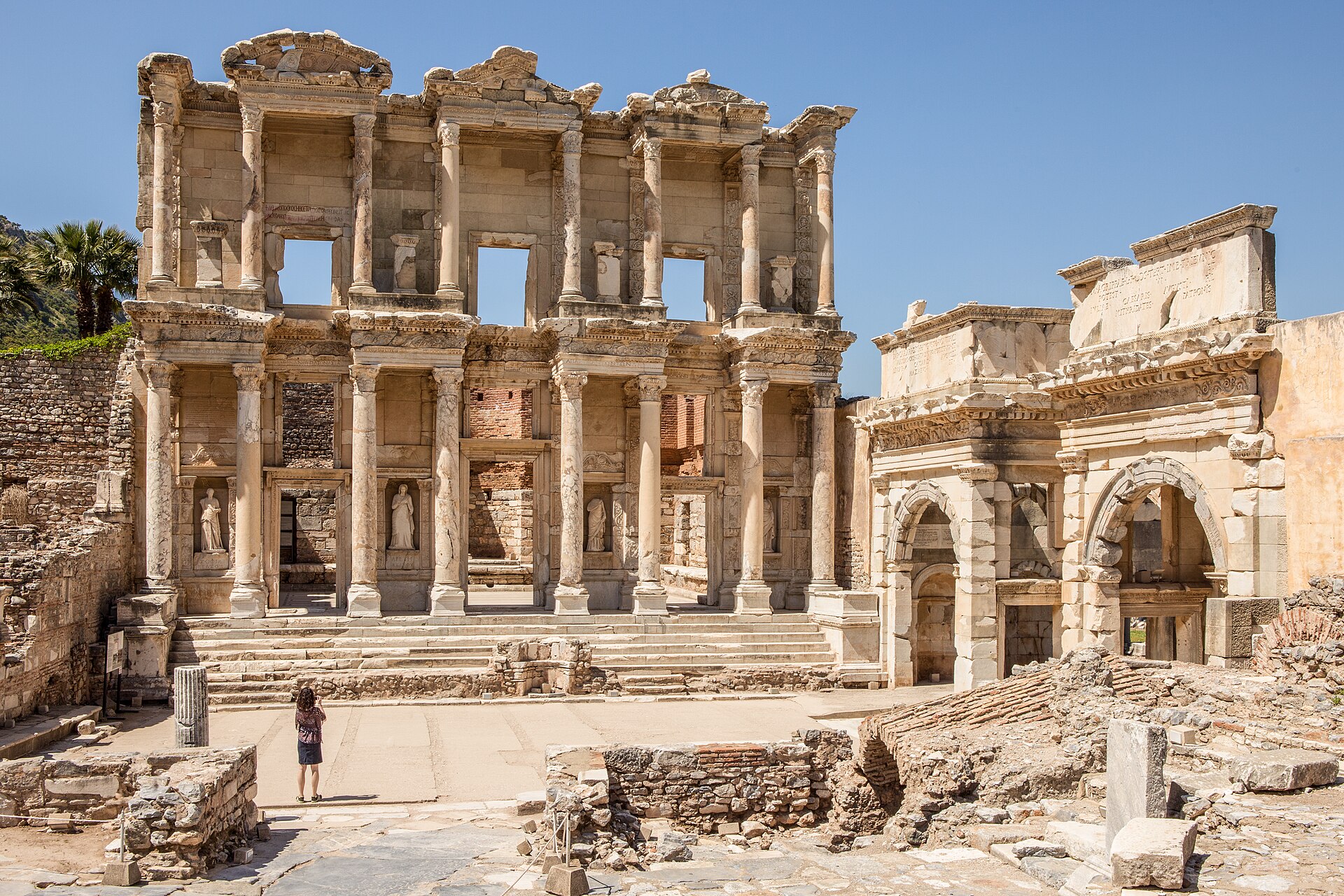
Ephesus is the ruin most people picture when they imagine walking through the classical world. On Turkey’s Aegean coast, it is one of the best-preserved ancient cities anywhere in the Mediterranean — not a scatter of foundations but whole streets you can walk, paved in marble, lined with columns and lit by the white glare of the reconstructed Library of Celsus at the bottom of the hill. It was once a major Roman port and one of the largest cities of the ancient world, and enough of it survives that you can read the shape of that city on the ground rather than on an information board.
The catch is that this is no secret. Ephesus is a fixture on Aegean cruise itineraries and a standard day trip from half the resorts on the coast, so on a busy morning you share the marble with a great many other people. Time your visit well and it is still one of the most rewarding half-days in Turkey. Time it badly — midday in high summer, on a heavy cruise day — and the heat and the crowds do their best to spoil it.
Where to base yourself
There are two natural bases, and they suit different trips.
Selçuk is the small historic town right next to the site, and the practical choice if the ancient world is the reason you came. It is within a few kilometres of the entrances, home to the Ephesus Museum, and close to the other sights clustered around the ruins. It is a real town rather than a resort, which some travellers prefer and others find quiet in the evenings.
Kuşadası, about 20 km away, is the coastal resort and cruise port. It has the hotels, the seafront and the nightlife, and it is where most cruise passengers step ashore before being driven up to the ruins. If you want a beach and a pool alongside your ancient history, this is the base to pick. Our guide to where to stay near Ephesus breaks down both in more detail.
Getting here is straightforward either way. Izmir (ADB) is the nearest major airport, roughly an hour to the north, with good domestic and international connections. Many visitors, though, never book a room at all — they arrive on an Aegean cruise, come ashore at Kuşadası and see Ephesus on a half-day tour before sailing on.
Inside the ancient city
The site has two entrances, an upper gate and a lower gate, and most people walk it downhill from the top — an easier route that saves the climb and delivers you to the Library at the dramatic end. Allow two to three hours as a minimum; there is more here than a quick loop suggests.
- The Library of Celsus. The image on every postcard, and rightly so. Its two-storey marble facade has been carefully reconstructed and anchors the lower end of the site. It is the one spot everyone photographs, so it is busiest — early or late is the trick.
- The Great Theatre. A vast hillside theatre that seated around 25,000, still used as a landmark of the city’s scale. From the top rows you look straight down the old harbour road.
- Curetes Street. The marble spine of the city, sloping between the upper gate and the Library, lined with column bases, shopfronts and the small, elegant Temple of Hadrian. Look for the surprisingly grand public latrines and the Odeon, a smaller theatre used for council meetings and concerts.
- The Terrace Houses. These are the sleeper hit, and they sit behind a separate extra ticket. Under a modern shelter, a block of Roman homes preserves mosaics and wall frescoes in remarkable condition — the everyday interiors that the open streets can only hint at. If you have any interest in how people actually lived here, they are well worth the surcharge.
What sits nearby
Ephesus rewards a little wandering beyond the main gates, and the surrounding sights fill out a second day comfortably.
- The Temple of Artemis, near Selçuk, was one of the Seven Wonders of the Ancient World. What survives today is humbling in a different way: a single re-erected column standing over the foundations, with storks often nesting on top. It takes ten minutes to see and a moment to absorb how completely a wonder can vanish.
- The House of the Virgin Mary, on Bülbül Mountain above the ruins, is a quiet pilgrimage site believed by many to be where Mary spent her final years. It draws Christian and Muslim visitors alike.
- The Basilica of St John and the Ephesus Museum, both in Selçuk, round out the picture — the basilica marking the traditional burial place of the apostle, the museum holding the finest small finds lifted from the site, including the statues of Artemis.
When to go, and beating the heat
Spring (April to June) and autumn (September to October) are the sweet spots: warm but not punishing, with the light kind to the marble. Summer is genuinely hot, and this matters more here than at most ruins because there is very little shade on the site — you walk open stone for hours. Go early in the morning or in the late afternoon, carry water, and bring a hat and sunscreen. The middle of the day in July or August is the combination to avoid.
Crowds follow the cruise ships more than the calendar. When several large vessels are in at Kuşadası, the site fills from mid-morning to early afternoon and the Library forecourt can be shoulder to shoulder. Arriving at opening, or coming back near closing, sidesteps the worst of it in any season.
Guide or no guide
Ephesus is legible enough to enjoy on your own, but it comes alive with context. The stones are impressive; the stories behind them — the harbour that silted up and killed the city, the riot in the theatre, the life inside the Terrace Houses — are what you remember. A licensed guide, or at least a good audio guide, turns a walk past ruins into an understanding of a city. Our Ephesus visiting guide covers tickets, timing and the guide question in full, and you can browse guided Ephesus tours — many combining the site with the Terrace Houses, the House of the Virgin Mary or a nearby lunch — before you commit.
Ready to plan it? Compare Ephesus tours, see where to stay in Selçuk or Kuşadası, and read our Ephesus visiting guide for the practical detail.


