
For close to a thousand years, the western edge of Anatolia belonged to the classical Mediterranean world. First Greek colonists settled its harbours, then Rome absorbed the whole peninsula, and the result is one of the greatest concentrations of ancient cities anywhere. Many of Turkey’s most visited ruins date from this long Greek and Roman era.
The Greek cities of Ionia
From around the 8th century BC, Greek city-states planted colonies along the Aegean coast in the region known as Ionia. These were not rough outposts but full cities in their own right — Ephesus, Miletus, Pergamon and Smyrna (modern Izmir) among them. Ionia became a centre of trade and ideas; some of the earliest Greek philosophers and scientists worked here, thinking about the natural world in ways that shaped everything that followed.
Alexander and the Hellenistic kingdoms
In the 4th century BC, Alexander the Great swept through Anatolia on his way east, ending Persian control and folding the region into the Greek-speaking world. It was at Gordion, according to tradition, that he cut the famous Gordian Knot rather than untie it. After his death his empire split apart, and a patchwork of Hellenistic kingdoms took shape. Pergamon in particular flourished under its own dynasty, building a spectacular hilltop city and amassing one of the great libraries of the ancient world — so great, the story goes, that a jealous Egypt cut off the supply of papyrus, forcing the city to develop parchment instead.
Under Rome: the province of Asia
When Rome took over, western Anatolia became the province of Asia, one of the wealthiest in the entire empire, administered from Ephesus. That prosperity paid for building on a scale still visible today.
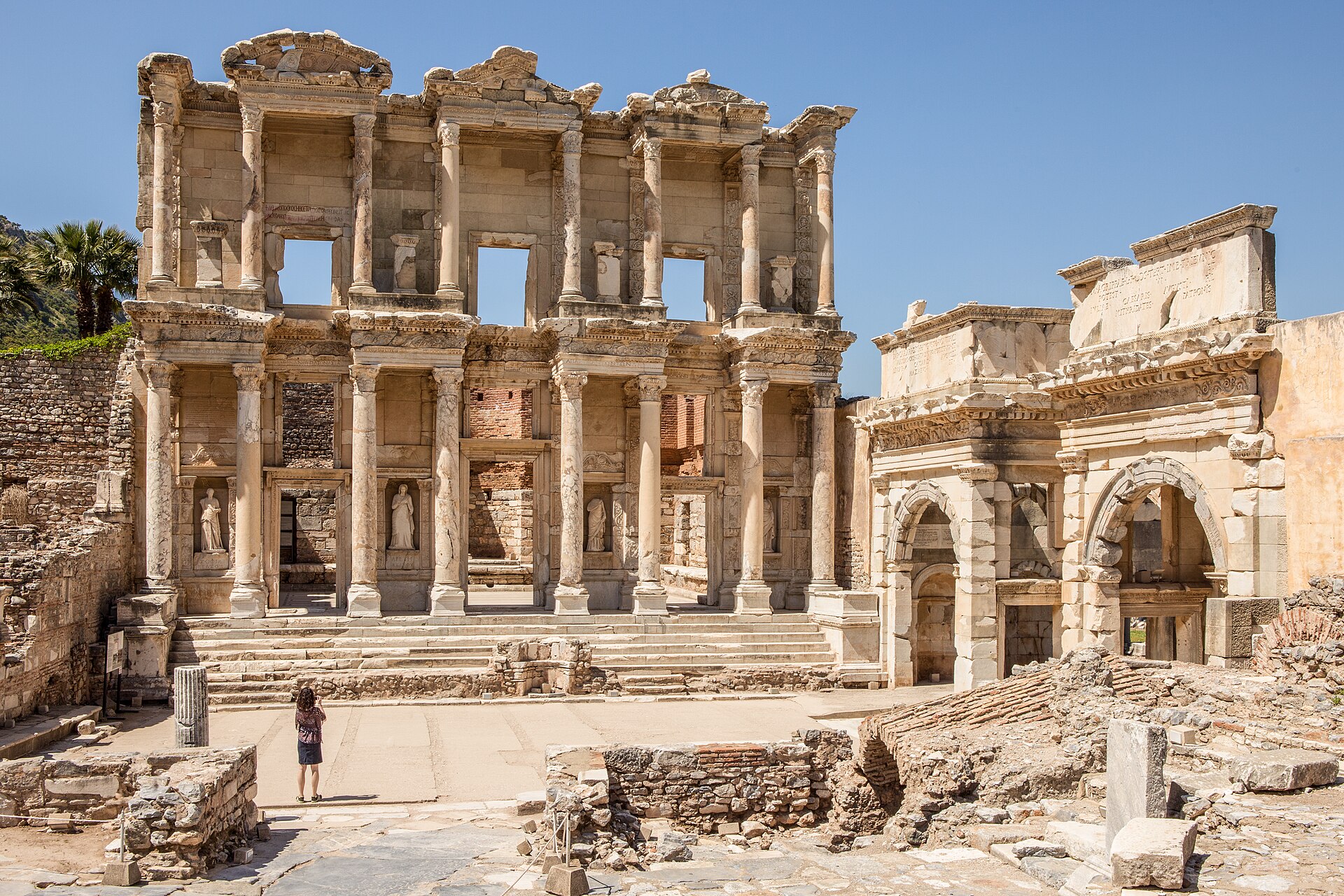
Ephesus grew into one of the largest cities of the Roman east, its marble streets, terraced houses and great theatre still drawing visitors. Pergamon was famous for its steeply stacked acropolis, its library, and the Asclepion, a renowned healing sanctuary. Aphrodisias, set inland among marble quarries, produced sculptors whose work was prized across the empire. And at Hierapolis, above the white travertine terraces of Pamukkale, Romans came to bathe in the thermal springs, leaving behind a huge theatre and a sprawling necropolis. Read our practical Ephesus visiting guide to see how much of this survives.
The birth of early Christianity
Anatolia was also one of the cradles of the early Church. St Paul was born at Tarsus in the south and travelled repeatedly across the peninsula, founding and writing to congregations along the way. The Seven Churches of Revelation — addressed in the New Testament — all lay in western Anatolia, including Ephesus, Smyrna and Pergamon. Christian tradition holds that the Virgin Mary spent her last years near Ephesus, and pilgrims still visit the house on the hill above the ruins.
Further inland, the soft volcanic rock of Cappadocia was later carved into churches, chapels and whole underground refuges by Christian communities, their walls painted with frescoes that survive to this day. You can read more in our Cappadocia overview.
Seeing classical Anatolia today
The Aegean and Mediterranean coasts of Turkey are, in effect, an open-air museum of the classical world. A single trip can take in the streets of Ephesus, the heights of Pergamon, the terraces of Pamukkale and half a dozen lesser-known sites in between, many of them far quieter than their fame deserves. This Greek and Roman inheritance set the stage for what came next, when the emperor Constantine moved the centre of the Roman world east and founded a new capital on the Bosphorus — the beginning of Byzantine Anatolia.
Browse our full destinations guide to plan a route through the ancient coast.