
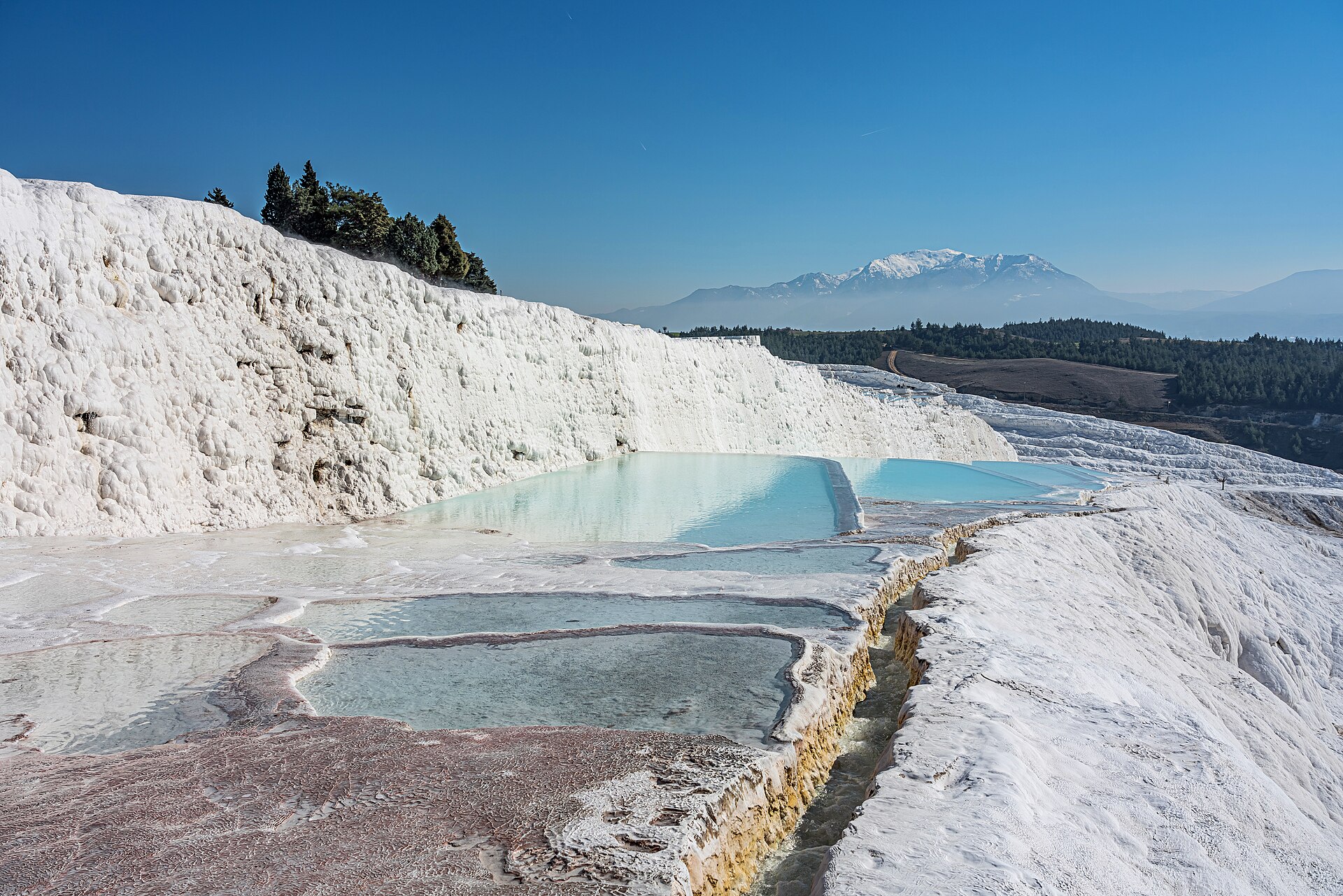
Pamukkale means “Cotton Castle” in Turkish, and the name does the describing for you: a hillside of brilliant-white terraces stacked one above the next, looking from a distance like snow that never melts or a frozen waterfall. There is no snow involved. The white is travertine — a soft, chalky rock left behind by calcium-rich thermal water as it cools and flows down the slope, depositing mineral layer on mineral layer over thousands of years. The result is one of the most photographed natural sites in Turkey, and, alongside the ancient city of Hierapolis on the plateau above, a joint UNESCO World Heritage Site.
It is worth being clear-eyed about what a visit involves, because Pamukkale is both simpler and more managed than its postcards suggest. The terraces are a protected surface, the water levels are controlled, and the site is busy for much of the year. Handled well, it is still a genuine highlight. Handled badly — the wrong time of day, unrealistic expectations of the pools — it can disappoint.
Walking the terraces barefoot
The single rule that shapes every visit: you walk on the terraces barefoot. Shoes are banned on the white travertine to protect it, so you carry them (or leave them at the entrance) and pad up and down the marked path in bare feet. The surface ranges from smooth and slippery where water runs over it to rougher and chalkier where it has dried, and it can be slick, so take your time.
Not every terrace holds water. The pools are fed and drained on a managed rotation to spread the flow and let sections recover, so on any given day some terraces will be full and waded, others merely damp, and some completely dry and bone-white. This is normal, and seasonal — the volume of water shifts through the year — but it does mean the image of endless brimming turquoise pools isn’t guaranteed. Where the pools are full, the water is shallow, warm and mineral-cloudy, and you can wade the sanctioned stretches. Elsewhere you simply admire the shapes.
Hierapolis on the plateau
Climb to the top of the terraces and you reach flat ground and something most first-time visitors underestimate: Hierapolis, a substantial Greco-Roman spa city that grew up around these same thermal springs. People came here to take the waters in antiquity for the same reason people photograph them now.
The ruins are extensive and easy to walk. The theatre is the standout — a large, well-preserved Roman auditorium cut into the hillside, with much of its seating and ornate stage still standing. Spread across the site is one of the largest ancient necropolises in Anatolia, a sprawling field of tombs and sarcophagi lining the old approach roads. There is a small museum housed in restored Roman baths. Give yourself at least an hour or two up here; skipping Hierapolis to see only the white slope is a common mistake and a real waste.
Cleopatra’s Pool
Also on the plateau is the Antique Pool, universally sold as “Cleopatra’s Pool.” It is a separate, ticketed thermal pool where you swim among fragments of fluted marble columns that toppled into the water in an ancient earthquake and were left where they fell. Floating over submerged Roman masonry in warm, faintly fizzy spring water is a novelty worth the entry for many — but manage expectations: it is popular, can be crowded, and the swim ticket is charged on top of the main site entrance. Bring swimwear if you intend to go in.
Getting there
Pamukkale is inland, in Turkey’s southwest, and reaching it takes some planning. The nearest airport is Denizli Çardak (DNZ), a short domestic hop from Istanbul or İzmir, with a transfer on to the town of Pamukkale that sits at the foot of the terraces. That town is small and geared to visitors, with the neighbouring thermal village of Karahayıt just up the road.
Many travellers, though, never overnight here at all. Pamukkale is a classic long day trip from the coast — from Antalya, from Kuşadası or Selçuk near Ephesus, or from Fethiye — each of which is roughly two and a half to four hours away by road, each way. That is a lot of driving for a site you can walk in a couple of hours, and the tour buses tend to arrive in the same midday window. Weigh the convenience of a packaged day trip against the long hours in a coach.
Day trip or overnight
The honest case for staying the night is timing. Day-trippers almost all land in the middle of the day, which is also the hottest and most crowded. Sleep in Pamukkale or Karahayıt and you can be on the terraces early in the morning or in the late afternoon, when the light is better, the heat is bearable and the crowds thin out. Sunset on the white travertine, with the pools catching the colour, is the site at its best, and it is far easier to reach if you are not facing a three-hour drive back to the coast afterwards.
If your schedule is tight and the terraces are a box to tick between Ephesus and the beaches, the day trip does the job. If Pamukkale is a place you actually want to experience rather than glimpse, an overnight changes it entirely. Our Pamukkale visiting guide walks through the gates, tickets and timing in detail.
When to go
Spring and autumn — roughly April to June, then September into October — are the most comfortable months, with warm days that stop short of the fierce inland summer heat. High summer is hot and exposed; there is little shade on the terraces or across the open ruins of Hierapolis, so if you come then, aim for early or late and carry water and sun protection. Winter is quieter and can be atmospheric, the white terraces under moody skies, though it is cold and some days are wet.
Whenever you come, a few basics travel well: water, sun cover, and swimwear if you want the Antique Pool or a wade in the terraces. Ready to plan it? Browse Pamukkale tours, see where to stay in Pamukkale or Karahayıt, or read our full Pamukkale visiting guide.


